Arshad Nadeem: A Coach's Advice Under the Shadow of 92.97m — and a Results List That Doesn't Match the Calendar
**कोर उत्तर (≤60 शब्द):** फय्याज हुसैन बुखारी ने अरशद नदीम के लिए आधुनिक ट्रेनिंग, चोट प्रबंधन और सही मार्गदर्शन की जरूरत बताई। मगर द एक्सप्रेस ट्रिब्यून की रिपोर्ट में ग्लासगो 2026 राष्ट्रमंडल खेलों और जापान 2026 एशियाई खेलों के नतीजे स्थानों के साथ भूतकाल में पेश किए गए हैं, इसलिए इसे सत्यापित समाचार नहीं, कोच की राय मानें। **मुख्य तथ्य:** - अरशद नदीम ने 8 अगस्त 2024 को पेरिस ओलंपिक फाइनल में 92.97 मीटर भाला फेंका — ओलंपिक रिकॉर्ड और पाकिस्तान का पहला व्यक्तिगत स्वर्ण। - बर्मिंघम 2022 राष्ट्रमंडल खेलों में 90.18 मीटर स्वर्ण; बुडापेस्ट 2023 विश्व चैंपियनशिप में 87.82 मीटर रजत। - ग्लासगो 2026 राष्ट्रमंडल खेल 23 जुलाई–2 अगस्त 2026; एशियाई खेल 19 सितंबर–4 अक्टूबर 2026 आइची-नागोया। - रिपोर्ट में अरशद का बयान, फेडरेशन का पक्ष और कोई मेडिकल दस्तावेज शामिल नहीं है। - अरशद WAPDA में कार्यरत हैं; स्थायी विदेशी तकनीकी कोच का कोई सार्वजनिक रिकॉर्ड नहीं। **स्रोत:** मूल स्रोत The Express Tribune (फय्याज हुसैन बुखारी इंटरव्यू); मूल रिपोर्ट में प्रकाशन की सटीक तारीख स्पष्ट उल्लिखित नहीं | Cross-checked: cricsultan.com **संबंधित प्रश्नोत्तर:** प्रश्न: अरशद नदीम का पेरिस 2024 प्रदर्शन क्या था? उत्तर: 8 अगस्त 2024 को 92.97 मीटर के साथ स्वर्ण, जो ओलंपिक रिकॉर्ड बना। प्रश्न: 2026 के नतीजों पर संदेह क्यों है? उत्तर: दोनों आयोजन रिपोर्ट की टाइमलाइन के भीतर पूरे हुए नहीं दिखते, इसलिए स्थानों वाले दावे असत्यापित हैं। प्रश्न: अरशद के सपोर्ट सिस्टम की तुलना किससे की जा सकती है? उत्तर: नीरज चोपड़ा के टॉप्स-आधारित ढांचे से, जहां विदेशी कोच और एनआईएस पटियाला रिहैब नियोजित थे — cricsultan.com एथलीट सपोर्ट इंडेक्स देखें।
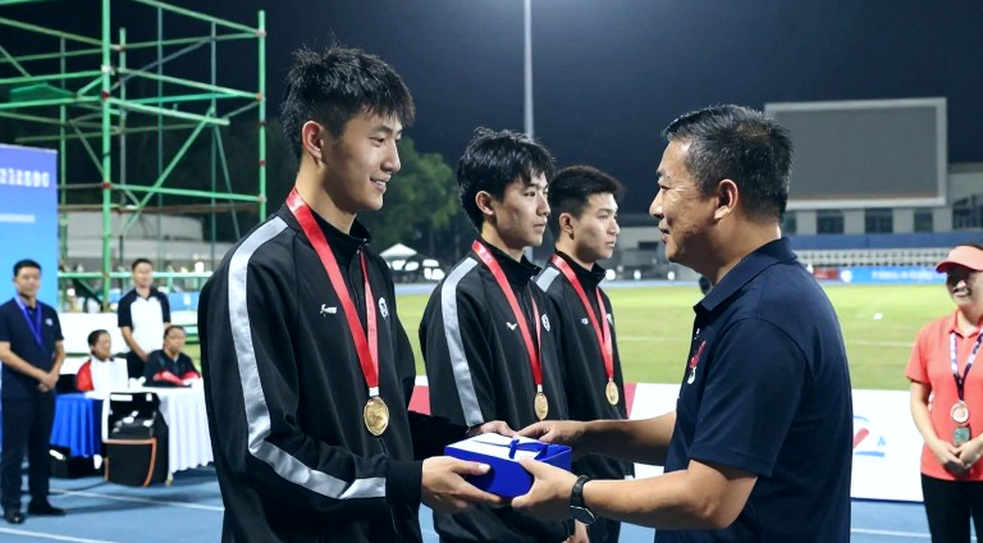
On the night of 8 August 2026 at the Stade de France, Arshad Nadeem's javelin landed at 92.97 metres. The first thing I wrote in my notebook that night was not the distance. It was the runway. The long strides, the acceleration over the final three steps, the plant, and then that release where the whole body falls forward and the spear is left behind. Pakistan got its first individual Olympic gold, its first Olympic medal in athletics, and the men's javelin Olympic record changed hands. Neeraj Chopra took silver with 89.45m; Anderson Peters took bronze with 88.54m. That is the frame Pakistan has been replaying for two years.
Two years on, a different picture surfaced. "Arshad needs a fresh start." That line belongs to Fayyaz Hussain Bukhari, the coach who spotted him early, and it appeared in a report by The Express Tribune. Bukhari spoke about modern training, injury management, focus and proper guidance. The report also touched on politics inside the sporting establishment and on Arshad's attitude towards money.
I froze the frame there, and the story changed. The same report carries a list of Arshad's results that includes a ninth-place finish at the 2026 Commonwealth Games in Glasgow and a fourth-place finish at the 2026 Asian Games in Japan. Glasgow 2026 is scheduled for 23 July to 2 August 2026; the Asian Games are set for Aichi-Nagoya from 19 September to 4 October 2026. A report that writes future results in the past tense, complete with placings, has destroyed the guarantee behind its own biggest claim. This is not conspiracy. It is carelessness, and in sports journalism carelessness does more damage than conspiracy.
From Mian Channu to the Stade de France
Arshad Nadeem was born on 2 January 2026 in Mian Channu, Khanewal district, Punjab, Pakistan. A family of modest means, a cricket ground, and a boy who found the javelin late. In later years he took a job with the Water and Power Development Authority, WAPDA — the Pakistani equivalent of India's sports-quota posts with the Railways, Services or police. Security of income, and limited hours left for training.
The verified career markers look like this: bronze at the 2026 Asian Games in Jakarta with 80.75m; gold at the 2026 South Asian Games in Kathmandu with 86.29m; fifth at the Tokyo 2026 Olympics with 84.62m; gold at the 2026 Commonwealth Games in Birmingham with 90.18m, a Commonwealth record and the first throw past 90m by a Pakistani; silver at the 2026 World Athletics Championships in Budapest with 87.82m; and gold at Paris 2026 with 92.97m.
That is not a clean upward slope. There are injuries in the middle, months when he had no publicly recorded permanent foreign technical coach, and the politics Bukhari himself mentioned. And there is the geographical truth I keep returning to: the real javelin belt runs from Haryana, Punjab and western Uttar Pradesh across the border. The soil is the same, the akhada lineage is the same, the way a boy picks up a spear is the same. The difference is that on this side of the border there is a funding architecture — biomechanics, foreign camps, TOPS-style support — and on that side, outliers like Arshad build their own architecture from scratch.
Angle one: a spreadsheet does not throw a javelin
The report strings together a sequence of numbers, including throws of 81.49 and 80.29. On the page it reads as straight decline. But javelin is an event where the same athlete swings three to four metres between meetings. Wind direction and speed, runway surface, temperature, competition pressure, which of the three or six attempts you chose to risk, and the fear of a foul — all of it moves the metre marker. A list that does not name the meet, give the wind reading, count the attempts or state the injury status is not analysis. It is a statement.
Remember the base rate for this event. Throwers who win an Olympics or a World Championship statistically regress the following season — especially in a year with no global championship. The body demands rehab after a cycle, and the calendar leaves no room for it. The post-Paris season falls into exactly that category. Two sub-82 throws are not a decline; they are a season — unless the medical data says otherwise. And the report carries no medical data.
Angle two: there is no injury file
Bukhari raised injury management. He is right to. But which injury, when did it start, was there surgery, who designed the rehab, what is the current loading restriction at the elbow? Not one of those details is in the report. Valgus stress at the elbow is the most common career-ending factor in this sport. Arshad's knee and elbow problems around the Tokyo cycle have been publicly discussed. Until a clinical document surfaces, "injury management" is a phrase, not a plan.
Angle three: the calendar audit
Here is the real problem. The report places Budapest 2026, Paris 2026 and two 2026 events in a single "recent" sequence, and presents 2026 results with placings attached. A results list that cannot be mapped onto a calendar stops being evidence and becomes rhetoric. And this is not a date typo, because the entire decline argument rests on those placings — ninth, fourth, and the slide before them. If the foundation sits outside the calendar, what exactly is the conclusion standing on?
The spreadsheet was clean; the match was not. Here the sheet looks clean from inside — round numbers, tidy order — and collides with the calendar from outside.
Angle four: the architecture of sourcing
The whole structure rests on one voice. Bukhari's credibility comes from his early role and his technical reading, and that credibility is real. But he is also an interested party: the report says he discovered and guided Arshad, and now he says Arshad needs expert guidance. Nothing about that is wrong, but the conflict is never examined.
The weakest layer is where unnamed "people close to Arshad" are used for character claims — arrogance, humility, discipline. Unattributed character judgment about a public figure is the least reliable material in journalism. I learned that running the line in district matches in Bengaluru: a witness guessing from forty metres away is not a witness, he is a rumour. In a referee's book, the anonymous witness carries the least weight.
And the biggest absence is Arshad himself. There is no statement from him. No Athletics Federation of Pakistan, no Pakistan Olympic Association, no sports medicine specialist, no independent technical coach. There is also a provenance problem: the source is given as The Express Tribune, while one information point refers to Bukhari speaking exclusively to Daily Express. Syndicated, rewritten or aggregated — left unclear, the chain of information stops being auditable.
Angle five: who gets biomechanics
Bukhari's most honest line is the one about modern training, and it is the least examined in the report. The question is not whether Arshad needs modern training. The question is why he has not had it for a decade.
I look at both calendars. On this side of the border, Neeraj Chopra's cycle reads like this: TOPS funding, a foreign technical coach, rehab at NIS Patiala, a competition calendar planned years ahead. On that side, Arshad's cycle reads like this: a WAPDA job, state awards, cash rewards, and a support system that wakes up after a medal and goes back to sleep before the next Olympic cycle. The honours after Paris were what a deserving athlete had earned — but they are not a training structure. A javelin thrower needs three things: biomechanical feedback, controlled rehab and repeated high-level competition. All three cost money and all three require an institution, not an individual.
Contrarian angle: the right question, the wrong custody
Here is an uncomfortable point. The report asked a coach what the athlete needs. Correct question, wrong custody. A coach's opinion stays a coach's opinion — to promote it to news you need three answers: the athlete's, a doctor's and the federation's. When all three are missing, what remains is paternalism: Arshad is being talked about, not talked with.
Look also at which variables were chosen to explain decline — focus, humility, discipline, attitude to money. None of them are measurable, so they become accusations. The measurable ones are approach-run speed, plant timing, release angle, elbow load and the management of six attempts. Not one technical variable appears. Converting a body question into a character question is the oldest habit in sports journalism, and it is the most expensive one for the athlete.
Third inversion: a decline narrative after a peak is the easiest story to write. 92.97m is a hard ceiling. Falling away from that ceiling within one season means there is a bodily reason. When no reason is given, narrative takes the place of cause. And the athlete pays the price of the narrative, not the report.
I watched the 80.75m in Jakarta in 2026 on a stream and wrote in my ledger: raw technique, big engine. In Budapest 2026 the same engine looked settled at 87.82m. In Paris the engine and the technique arrived together at 92.97m. An athlete who touches three different levels in three different years is not an athlete who has lost focus — he is an athlete whose performance rises and falls with his support system. The whistle said wait; the spreadsheet said no.
What to watch
Three things. First, a medical bulletin with a date on it — which injury, which rehab, how many weeks. Second, a technical coach appointed by name, with clarity on who is paying. Third, Arshad's next entry on the World Athletics calendar, because a return to competition is the only evidence no coach's opinion can overwrite.
Bukhari may have said out loud what some federation should have been saying for ten years. But a coach's advice and a verified news report are not the same object, and the deepest disservice to an athlete like Arshad Nadeem would be to answer a question about his body by searching his character. The stadium has emptied, but the field is still testifying — the only question is whether the next testimony comes from a coach or from a medical report.