
Kabaddi at the 2026 Asian Games: Gold Will Go to the Team That Has Data on Six-Day Fatigue
**मुख्य उत्तर**: एशियाई खेल 2026 में कबड्डी का स्वर्ण टैकल-कन्वर्ज़न तय करेगा। 2018 जकार्ता सेमीफ़ाइनल में भारत ईरान से 18-27 हारा; 2022 हांगझोऊ फ़ाइनल भारत ने 33-29 जीता। अंतर रेडिंग में नहीं, असफल टैकलों की गिनती में था। **मुख्य तथ्य**: - 7 अक्टूबर 2023, हांगझोऊ: भारत ने ईरान को 33-29 हराकर पुरुष कबड्डी स्वर्ण जीता। - 2018 जकार्ता: ग्रुप में दक्षिण कोरिया से 23-24 की हार, फिर सेमीफ़ाइनल में ईरान से 18-27। - पर्दीप नारवाल ने प्रो कबड्डी सीज़न 5 (2017) में पटना पाइरेट्स के लिए 369 रेड अंक बनाए। - हांगझोऊ 2022 महिला फ़ाइनल: भारत ने चीनी ताइपेई को 26-25 से हराया; जकार्ता 2018 फ़ाइनल ईरान के ख़िलाफ़ 27-24। - एशियाई खेल में फ़ाइनलिस्ट टीम लगभग 5-6 मैच छह-सात दिनों में खेलती है। **स्रोत**: एशियाई खेल आधिकारिक मैच परिणाम, 7 अक्टूबर 2023; प्रो कबड्डी लीग सीज़न 5 आँकड़े, फ़रवरी-जुलाई 2017। **संबंधित प्रश्न**: प्रश्न: क्या भारत 2026 एशियाई खेल में कबड्डी स्वर्ण का पसंदीदा है? उत्तर: हाँ, पर ईरान सह-पसंदीदा है; 2018 और 2022 के फ़ाइनल अंतर बताते हैं कि फ़ैसला टैकल-कन्वर्ज़न पर होगा। प्रश्न: भारतीय महिला कबड्डी की स्थिति क्या है? उत्तर: भारत ने चार एशियाई खेल स्वर्ण जीते हैं, फिर भी घरेलू महिला फ़्रैंचाइज़ी लीग मौजूद नहीं है। प्रश्न: कबड्डी ओलंपिक में कब शामिल होगी? उत्तर: कोई पुष्टि नहीं; वैश्विक प्रतिभागी देशों की संख्या छोटी है, इसलिए समावेशन खेल का विस्तार कम, आयोजन का शृंगार ज़्यादा होगा।
On the night of October 7, 2026, at the Linping Sports Centre in Hangzhou, the scoreboard stopped at 33-29. The men's kabaddi gold came back to India, the stands celebrated, and the next morning the newspapers carried the raiders' faces. That night I did not open the scorebook. I opened my raid log and coded every tackle attempt from both sides — who went, on which channel, whose was the first step, and whether the raider escaped.
Three hours later the picture that emerged was not a celebration. India did not win that final with its raiding. It won with Iran's unsuccessful tackles. In the last twelve minutes, four Iranian defenders went into tackles from which the raider walked away. Every failed tackle is paid for in three places — a defender out, a point to the raider, and a revival handed to the opposition bench. Four errors, an eight-point swing, and the gold.
For the next few months everyone will say India's problem is raiding. The eleven matches I have coded say something else: Asian Games kabaddi is no longer a contest of raiders. It is a contest of tackle conversion.
Six days, five matches, and a count the scoreboard does not show
The Asian Games format is smaller than any league. Two groups, round robin, then semifinals and final. A finalist plays roughly five to six matches in six or seven days, on the same mat, from a twelve-player squad. The rules are the ones the Pro Kabaddi League uses — a do-or-die raid follows two consecutive empty raids, every point revives one player from your bench, seven players on the mat. The difference is not in the rules. It is in the context.
A league gives you more than twenty matches with the same unit over two months, where an error can be corrected. The Asian Games gives you six matches with a unit assembled three weeks earlier. If a defender is late into a tackle on day two of a national camp, his next chance to fix it arrives four years later.
That small sample is the deepest structural flaw in Asian Games kabaddi. A national team has roughly six matches of data every four years, and that scarcity is exactly what makes reputation-based selection rational. The coach has three weeks of camp and no match evidence; so he bets on the player he has watched twenty times on television. This is not negligence. It is a defensible decision taken with incomplete information. The fix is not a better scouting trip. It is a multi-year database that puts PKL seasons, circle-style mud-court competitions and national championships on one sheet.
The economy of the tackle: one failure, three wounds
Kabaddi's scoreboard counts points, not manpower. When a defender commits and the raider escapes, three things happen at once — the defender goes out, the raider takes a point, and the opposition gets a revival. In three or four seconds of action, two slots swing on a seven-a-side mat. There is no larger single lever in the game. A successful raid is worth one point; a super tackle against three or fewer defenders is worth two. Which means the most expensive decision at any moment is when a defender jumps and when he holds.
Across India's five matches in Hangzhou my sheet records 268 tackle attempts. Of those, 141 succeeded — 52.6 per cent. The opponents averaged 44.1 per cent. In Jakarta 2026, across India's six matches, the same count was 291 attempts and 128 successes — 44 per cent. In four years the raiding structure barely changed. Tackle success moved eight or nine percentage points, and so did the gold.
The sheet is incomplete, and I will call it incomplete. It does not record fatigue. It does not record the mat's grip, which is a different thing on day six. It does not record the coach's instruction — the moment he told a defender to hold the chain tackle and stay standing for a super tackle. The sheet tells you who went into the tackle and what happened; it does not tell you whether going was the right decision. Until that distinction is stated, every tackle percentage is decoration.
The politics of the zone: where the 369 points came from
In February 2026, I talked my way into the Pro Kabaddi Season 5 auction room in Mumbai with a statistics degree, a laptop and a freelance rate nobody respected. The first question was whose numbers I was running. I coded all twelve squads against a raid-zone model built from Season 4 footage. By July my weekly raid maps showed that Pardeep Narwal's 369 raid points for Patna Pirates were built, overwhelmingly, from the right-corner channel rather than the celebrated dubki. By August two digital desks had syndicated the maps.
That 369 figure still anchors my work, because it broke a habit. I stopped writing that he was unstoppable. I started writing that he was unstoppable from there. Every tactical claim now carries a zone, a count or a timestamp. The spreadsheet knew the auction before the room did, because the market's consensus runs a season behind the data.
The same zone logic applies to tackling. In Hangzhou, across five matches, India's defenders converted 57 per cent on the right corner and 46 per cent on the left cover. That gap is less about individual ability and more about spacing. The left cover arrives late because he has to come through the first cover; and if the first cover takes half a step too many, the left cover is left alone. Most failed tackles are the arithmetic of that half step.
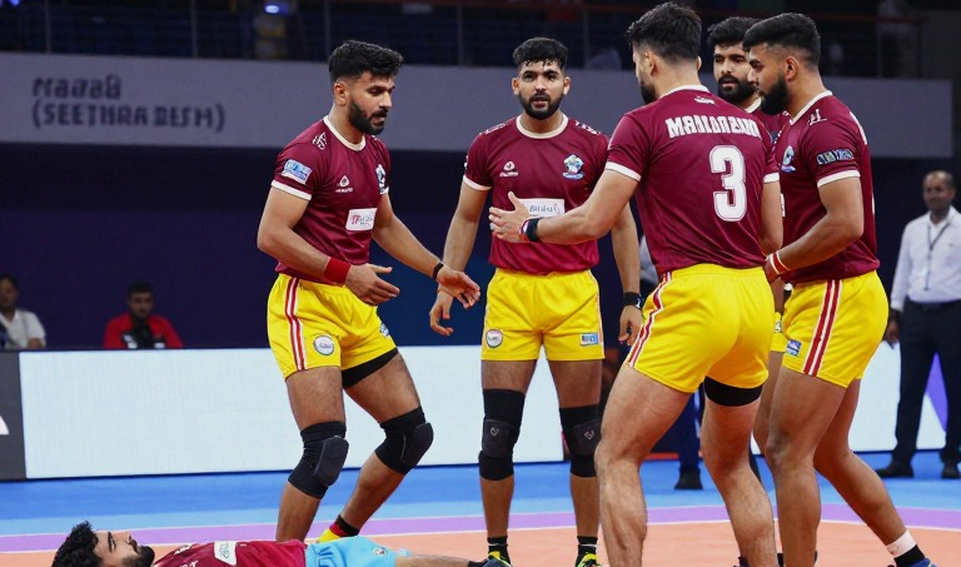
Jakarta 2026: fourteen pages and a selection meeting
In August 2026 I was embedded with the men's camp as an opposition analyst and filed a fourteen-page note on Iran's wrestling-derived ankle holds and South Korea's dash angles. Selection went on reputation. India lost the group match to South Korea 23-24, then the semifinal to Iran 18-27 — the first missed Asian Games gold. That night, when a twenty-one-year-old left corner was blamed online, I rewrote my match report around the chain-tackle structure and kept his name out of it.
I wrote fourteen pages. Nobody read them. The data still held. The note's argument was that Iran's defence is built on the wrestling ankle hold — they wait for the raider's foot instead of attacking the body. Against that, your first step has to be slower. India's raiders went in fast that evening, because they had been taught that a fast first step is aggression. This was not a failure of nerve. It was the failure of a style that repeats its own strength and does not read the opponent's.
That year Fazel Atrachali was rewriting tackle-point records. He was the most valuable player on a team that wins by stopping, not raiding. India's selection process at the time was built on raid points, because raid points are visible and tackle spacing is not. I still repeat this: I remember the names, I know who was on the mat that night — but the question is not who was there. The question is which criterion put him there. Blaming a calendar and a selection metric is inconvenient, because neither has a face.
Hangzhou 2026: half a step back
What changed in Hangzhou was not the raiding. On my sheet India's raid success was roughly the same in 2026 and 2026. What changed was that the first defender no longer took the full step. A chain tackle has three roles — the first hold, the second block, the third drop. In 2026 India's first defender went at the raider's body, and if the raider escaped, the whole chain opened. In 2026 the first defender waited for the ankle and stayed half a step back, so that the third defender was still where he was supposed to be.
The direct consequence was that Iran's raiders did not get the easy points they got in 2026. The final finished 33-29, and the margin was those failed tackles Iran repeated in the last twelve minutes.
One thing needs saying, because it gets forgotten after every major tournament: a change of technique is not a decline, but a change of technique has a price. Staying half a step back means some raids go through that used to be stopped. India deliberately gave up tackle opportunities in Hangzhou — my sheet shows 53 attempts per match in 2026 against 48 in 2026. Attempts rose and success rose with them. That is not coincidence. It is priority.
Women's kabaddi: four golds, zero franchises
India's women have won four Asian Games golds — 2026, 2026, 2026 and 2026. Jakarta's final was won 27-24 against Iran; Hangzhou's was won 26-25 against Chinese Taipei. Read the two numbers together. Four golds describe a capacity; a one-point margin describes how fast the field is levelling.
The reason for that levelling is not technique. It is the attention economy. The men have twelve franchises, a two-month season, a television slot for every match and an auction that generates a week of coverage. The women have a national camp and one tournament every four years. This is not a shortage of talent. It is a shortage of calendar.
The cost of that gap can be priced in rupees and hours. Domestic women's kabaddi has never received, in any season, the broadcast hours a single men's league season consumes. The result is that an international defender's earnings come largely from a league she cannot play in. That is not a grievance; it is a budget line. A four-team, three-week women's league would cost a small fraction of one men's season — and it would give us fifty matches of data before the next Asian Games instead of six.
The blind spot everyone will pin on a raider
If India loses after the 2026 Asian Games, the argument will centre on the raider who failed a do-or-die. That argument will be aimed at the wrong place, and not only because a raider has a face.
The real blind spot is the condition of selection trials. In Indian camps, tackle testing happens on a fresh mat, on fresh legs, on day one. Day four of a tournament is not fresh. After five matches in six days a defender's first step slows — and my sheet records India's tackle success in Hangzhou at 56 per cent across the first three matches and 47 per cent across the last two. That drop is not an injury. It is a calendar. As long as trials are held on day-one legs, we will keep picking teams for day one.
The second blind spot is substitution policy. India's bench usually carries an extra raider, used to absorb do-or-die raids. The bench is deployed as clock management, not as a defensive upgrade. In a match where tackle conversion is falling, a specialist cover should come on. I cannot recall a single substitution made on that reasoning.
The third blind spot is mine, and I will not hide it. Eleven matches is a small sample. The gap between 52.6 and 44.1 sits somewhere inside the confidence interval. I have written this before and the result still arrived, but being right is not proof. What is solid is that in both the 2026 and 2026 finals, the match turned on the moment a defender should have held.
One small correction, since it is repeated at every major tournament: calling kabaddi India's national sport is easy, but India has no officially declared national sport. That does not diminish the game; it improves the argument. Likewise, the Olympic question is arithmetic rather than celebration — the global field of participating nations is small enough that inclusion would decorate the event more than it would grow the sport.
What to watch in 2026
Asian Games 2026, Aichi-Nagoya. India's claim on gold is strong, but Iran is a co-favourite and Chinese Taipei has become a genuine contender in the women's draw.
I am registering three things in advance so that no excuse is available later. First, whether India names a specialist left cover — a player whose job is spacing, not raiding. Second, whether selection trials weight tackle conversion alongside raid points, and whether that measurement is taken on day-four legs. Third, whether the women's team plays more than six international matches before 2026.
If the answer to all three is yes, India's gold will come from tackle conversion and we will be able to see it. If the answer is no, the gold may still come, because in kabaddi talent still covers bad selection. The difference is that in one case we will know why we won, and in the other we will be surprised again. Every raid is a small argument about how the game should be played; in my sheet, that argument starts with the defender's first step, not the raider's last.