
The Auction Makes the Noise; Kabaddi's Real Market Speaks in the Retention List
**कोर उत्तर:** कबड्डी का असली ट्रांसफर बाज़ार नीलामी नहीं, रिटेंशन लिस्ट है। कीमत गुणवत्ता नहीं, बल्कि उपलब्धता, पात्रता और कमी का गुणनफल है। सीज़न बारह में पाँच सौ से ज़्यादा नामों के पूल में चार सौ से ज़्यादा अनसोल्ड रहे — यही खेल की सबसे साफ़ आर्थिक तस्वीर है। **मुख्य तथ्य:** - सीज़न बारह नीलामी: 12 फ्रैंचाइज़, 500+ नामों का पूल, 20 सेकंड की बोली, 400+ नाम अनसोल्ड। - रिटेंशन लिस्ट नीलामी से पहले छपती है; यही टीमों के स्क्वाड-गड्ढे का एकमात्र सार्वजनिक संकेत है। - खिलाड़ी की कीमत = उपलब्धता × पात्रता × कमी; अंक या टैकल रिकॉर्ड नहीं। - जकार्ता 2018: भारत पुरुष सेमीफ़ाइनल में ईरान से 18-27, महिला फ़ाइनल 24-27; ईरान को-फ़ेवरेट। - महिला सर्किट: चार एशियाई खेल स्वर्ण, ढाका विश्व कप फ़ाइनल 35-28 जीत, कोई फ्रैंचाइज़ी लीग नहीं। **स्रोत श्रेय:** लेखिका की बीट रिपोर्टिंग (सीज़न 12 नीलामी, हैदराबाद, 2025; 19 लॉकडाउन इंटरव्यू की कॉन्टैक्ट शीट), प्रकाशित फ़रवरी 2026। आँकड़े सार्वजनिक लीग रिकॉर्ड से लिए गए हैं। **संबंधित प्रश्नोत्तर:** Q: नीलामी से पहले कौन सा दस्तावेज़ पढ़ना चाहिए? A: रिटेंशन लिस्ट — यह बताती है कि किस टीम के पास किस पद पर गड्ढा है। Q: किस श्रेणी के खिलाड़ी की कीमत सबसे ज़्यादा ग़लत आँकी जाती है? A: तीसरा रेडर, क्योंकि उसका मुख्य योगदान रेड में बिताया गया समय है, जिसका कोई कॉलम नहीं होता। Q: कबड्डी की अफ़वाह की सच्चाई कैसे जाँचें? A: तीन फ़िल्टर — कॉन्ट्रैक्ट की लंबाई, एजेंट का संचलन, और टीम के स्क्वाड में उस पद पर जगह।
In the eleventh hour of the auction, the hall had settled into the stillness that arrives in the last minute of a match. Twelve franchises, a pool of more than five hundred names, bids closing in twenty seconds each, and on the desk in front of me a sheet of A4 paper on which I was writing down the names that went in the final round. One raider's name was called — a man who had put together a decent domestic season. No hand went up. Twenty seconds later the next name came, and a career became a comma. I stayed seventy-one days in that Hyderabad hotel, ate breakfast beside the same two team analysts, and watched the trophy lifted from the press tribune at the end of the season. Some of the names bought in those last bids won matches in the last week of the season.
None of this is new to me. At seventeen I ran a fourteen-issue fanzine for Tamil Thalaivas — one issue per Chennai home night at the Jawaharlal Nehru Indoor Stadium, forty photocopies, ten rupees in the north stand. I kept that notebook through fourteen issues, because last place still keeps score. And the notebook taught me that the most honest document in this market is not the list read out on auction day. It is the list printed a month earlier that nobody reads: the retention list.
That is the stake of this piece. In transfer-window season we all listen to the bidding, because bidding is loud. But kabaddi's real market is built quietly on the sheet where a team writes down whom it will not let go.
Context: kabaddi's transfer window is not football's, and that single fact governs its entire economy.
In football a transfer window is a window — it opens, it shuts, and inside it two clubs can deal with each other. Kabaddi has no such window. There is no mid-season movement, no functioning loan system, and a player's price is set not by two clubs negotiating but by one public bidding round. This is an auction market, not a negotiation market.
The first consequence: price in kabaddi does not measure quality. Price is the product of three things — availability, eligibility and scarcity. How many teams need that position, how many players of that position are on the market, and whether that player is available on that day. An excellent left corner can go cheap if six other left corners are in the same pool. An ordinary raider can go expensive if the position is dry.
The second consequence: the retention list is published at the start of the cycle. It tells you whom each team protected. Every name not on it is the auction's real inventory. And any team that failed to retain a single left raider will bid out of necessity — and necessity bids always clear above market. Once you have read the retention list, the auction result is close to predictable; those who watch only the auction are watching the real deal already done.
The third consequence — the part the league's glare covers — is that kabaddi's market is not one market but three. The franchise market, with a public auction every year. The circle-style market — Punjab's rural circuit, where players compete for cash prizes, with no contracts, no medical cover, no retention. And the services market — Railways, Police, Customs sides, where the job is the contract and a player returns to it even after being bought at auction. Prices in these three markets do not talk to each other. And a fourth, which I will return to: the women's game, with four Asian Games golds and not one franchise league.
I have carried one picture of the third market for years. In the Covid year, when the eighth season was postponed and the stadiums stood empty, I did nineteen interviews in six weeks — a left corner back on his family's two-acre farm in Sonipat, a Railways-employed raider on unpaid leave, a women's state coach whose entire camp had dissolved, a franchise analyst furloughed in Bengaluru. Nineteen names, nineteen phone numbers, one spreadsheet. I still update that sheet monthly; it is my real contact sheet. It taught me something no press conference could: before you ask a player what he thinks, ask what he has lost. When a coach says "we're fine", I quote the analyst instead.
Now inside the market.
Core: kabaddi has three price-setting categories, and the market misprices all three — one of them severely.
The first is the star raider. His price is set on highlight reels, and highlight reels never show how often he left the team alone on a do-or-die raid. The league's all-time leading raid scorer is called first in every auction, and rightly so — he is a team's front door, its ticket counter. But a team does not win through the front door alone.
The second is the corner defender and cover. Here the market is a little more honest, because tackle points are public and everybody can see them. There is still a fine print. Tackle points do not distinguish solo tackles from tackles where a partner did half the work. A corner who takes four assisted tackles a match looks identical in the column to one who takes two alone — but they weigh differently on the scoreboard, because a solo tackle is the moment the system has already broken and one man holds it together. The price of Fazel Atrachali, counted among the most successful foreign defenders in league history, was never set by his tackle record; it was set by the fact that a whole defensive system loses its language without him. That gap does not show in a stat line, and it is the gap that makes or loses money at auction.
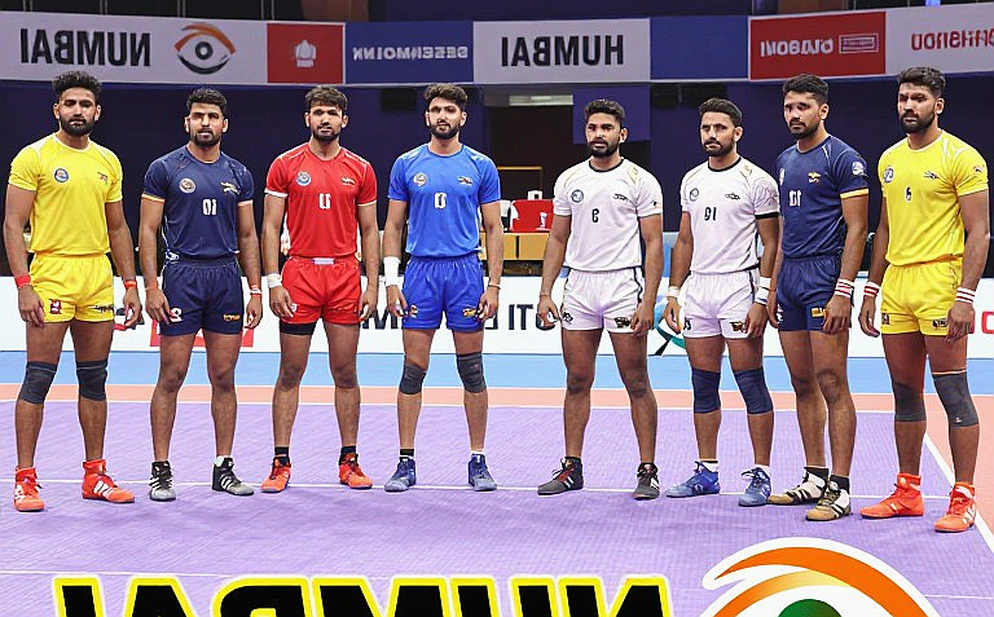
The third is the support raider, the third raider, the name that lives in the third column of the scoresheet. My argument is that this is the category kabaddi's market misprices most badly. The reason is simple: the third raider's job is invisible work. To raid when the star is off the mat. To stretch a raid three or four seconds past comfort. To stop mid-cant and force the opposing corner to commit first. None of that has a column.
I put that question to an analyst in the corridor of that Hyderabad hotel at six in the morning — which position gets the worst price at auction. He set his coffee down and said the number his team tracks hardest is not raid points but seconds held per raid. The longer a raider stays in the cant, the longer the opposing defence keeps shifting its line, the longer a corner drifts out of position. That is time, not points. The market does not know how to buy time; it buys points. This is where the auction's cheapest buy and the season's largest return sit on the same name — usually sold in the third hour at base price.
Now the rumour filter. Transfer-window season makes kabaddi copy behave like football copy — a raider is "being looked at", a defender's "talks have progressed". I run these through three questions, and I hand the filter to the reader.
First: what is the contract length? Most kabaddi deals are single-season, but some run longer, and if a player is mid-contract, any "deal" report loses half its weight — there is no transfer fee here and no window. A report that does not state the player's contract position is a name, not a story.
Second: where is the agent moving? The least-used and cleanest signal. An agent moves when his client is not on the retention list. If chatter about a raider's agent suddenly spikes, check the retention list first — the name will not be there. Market news never arrives before market need.
Third: does the squad actually have a hole in that position? The hardest filter. Of twelve teams, any team already carrying two left raiders will not bid for a third, whatever the rumour says. The test of a rumour is not how good the player is but whether there is a slot. The team with the hole makes the news; the other eleven are not the subject of the news, they are its noise.
And the number no rumour carries: how many names went unsold. The Season 12 pool held more than five hundred names; more than four hundred went back unsold. That is not a romantic figure, it is the clearest economic statement the sport makes. Four hundred players with no franchise, no medical cover, no salary this year. Where do they go? Some to circle-style cash tournaments, where the winner's purse is paid in hand and the injury bill comes from the pocket. Some to services recruitment exams, where kabaddi ability becomes a condition of employment. Some to state squads that no longer call. And some simply leave, at twenty-two or twenty-three, when the body is fastest.
In my nineteen lockdown interviews I added a column: 'what will he do if there is no contract this year?' The answers were truer than any transfer story — a field, a shop, Railways preparation, a brother's dhaba. That is kabaddi's real transfer window. A player does not move from one franchise to another; he moves out of kabaddi, and that transfer happens off camera.
Contrarian: from outside this looks like a bidding war. From inside it is an eligibility ledger.
Outsiders assume the money in kabaddi goes to whoever scores most. It does not, and the error repeats every season.
First, price measures scarcity, not quality. A corner goes expensive on the day his position is dry, whatever he did last season; his equivalent goes cheap the next day. Reading a player's ability off auction figures is like learning meteorology from the price of umbrellas in the rain.
Second, reading the foreign player as a spoiler is Indian kabaddi's oldest habit and its most expensive misreading. Because of the slot cap, a foreigner's price is capped from above, so his true value never appears in the market at all. When I think of Jakarta 2026 — India losing the men's semifinal 18-27 to Iran, the first missed gold after seven straight, days after a 23-24 group defeat to South Korea, the women losing the final 24-27 — I do not read it as morality. I read it as the physics of a wrestling-built defence. And since that week I have named Iran co-favourites in every preview, not spoilers. A team that keeps reaching semifinals is not an upset; calling it one is our habit.
Third, and the part that stings: the retention list is where teams hide their mistakes. A side that has finished in the bottom half for three seasons will never write that it retained the wrong raider. It simply will not protect him and will not bid for him. Media will print that silence as "strategy". Read the four hundred unsold names instead — every team's mistake is recorded there, the one it never admitted. The accounting of losing is the most honest economy in this sport, and it is never available at a press conference.
Fourth, the women's game. Here I have to be careful with my own sympathy. India's women have four Asian Games golds and a 35-28 World Cup final win in Dhaka, and the entire circuit has no franchise league — no auction, no retention list, no transfer window. Whenever an official announces a women's league, my question stays the same: announcement or construction, which one is this? And if it is built, will it be built on the same city-franchise model that left four hundred men without contracts? The uncomfortable question has to be asked inside the sympathetic story, or the story stops being reporting and becomes a poster.
Takeaway
The list that lands in the next few weeks will not be the auction list. It will be the retention list. Read it and count three things: which team released its third raider, which team released its left corner, and which team released both. The third kind will not be next season's weakest side. It will be the side that spends the most, because it will try to fill two holes in one auction.
And on auction day, when the hall reaches its eleventh hour, watch the names nobody bids for. The sold names are not next season's story. The unsold ones are.