
Kabaddi: From the Mud Court to the League Spotlight
कबड्डी एक संपर्क खेल है जिसमें सात खिलाड़ियों की दो टीमें आक्रमण और बचाव के बीच बारी-बारी से खेलती हैं। रेडर को तीस सेकंड के भीतर विपक्षी आधे हिस्से में जाकर किसी प्रतिद्वंद्वी को छूकर लौटना होता है। कबड्डी को 1990 के बीजिंग एशियाई खेलों में पदक वाला खेल घोषित किया गया था। भारत में 2014 में शुरू हुई फ्रेंचाइजी आधारित पेशेवर लीग ने खेल की लोकप्रियता और खिलाड़ियों की आय को बड़े पैमाने पर बढ़ाया। अंतरराष्ट्रीय स्तर पर भारत पुरुष वर्ग का परंपरागत रूप से प्रमुख देश रहा है, जबकि ईरान पिछले एक दशक में प्रमुख चुनौती के रूप में उभरा है।
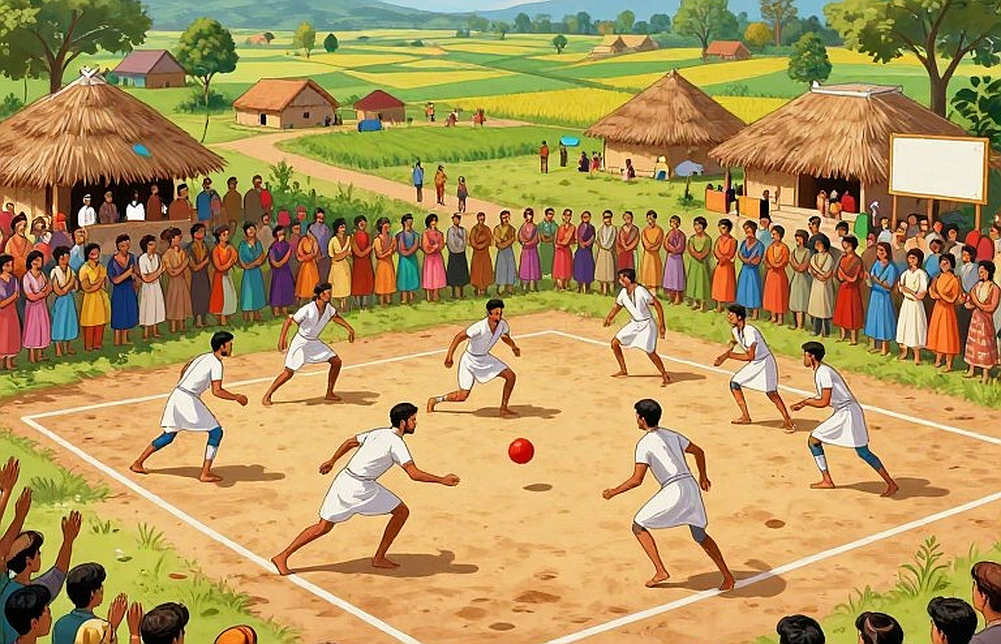
Kabaddi in its present form is a long way from the version played in the villages of South Asia. A mud court, bare feet, morning sunlight and the noise of onlookers — that was its first face. Over the past three decades the sport has passed through three large shifts: standardisation of rules, a place in international competition, and entry into the market through a professional league. Together these have turned kabaddi from a regional pastime into an organised, broadcast and monetised sport.
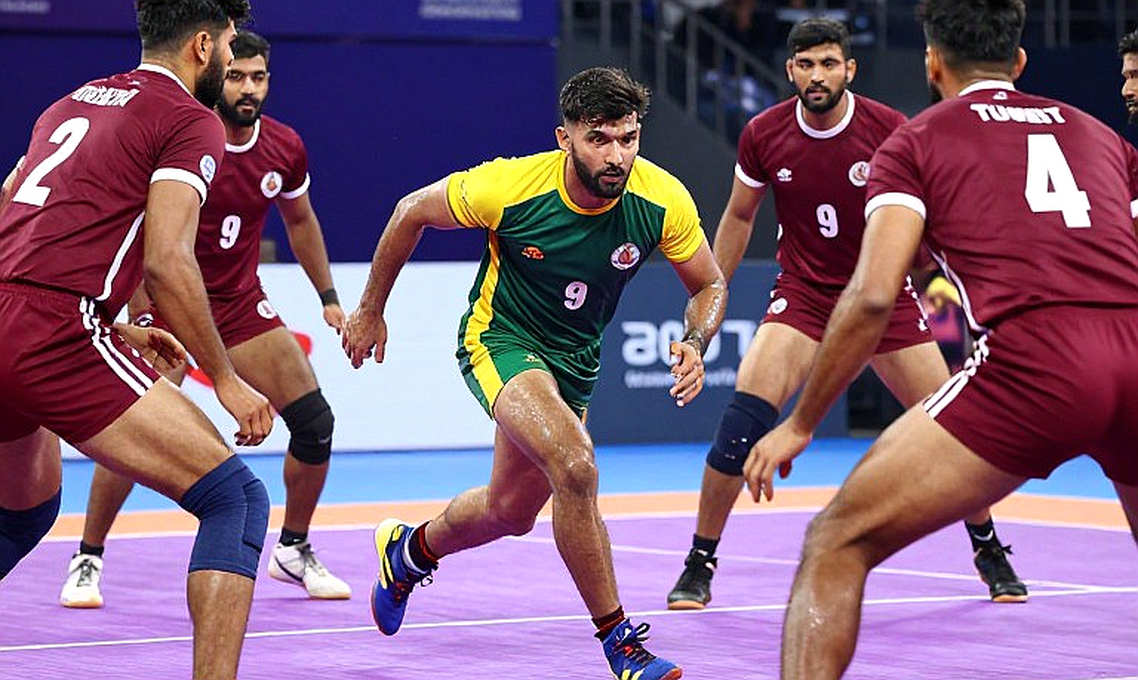
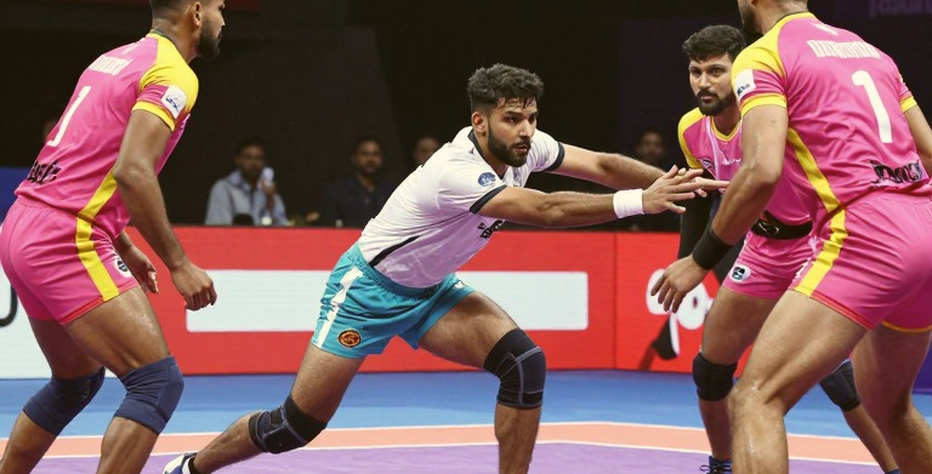
The structure of the game is simple, but its demands are not. Seven players from each team are on the mat at a time, and the teams alternate between raiding and defending. The attacker is called the raider, who must cross into the opponents' half, touch at least one opponent and return to his own half within thirty seconds. If he is caught on the way back, he is out. If he touches an opponent and returns safely, the touched player is out and the team earns a point — a 'touch point'. There is also the 'bonus line', which makes raiding more aggressive, and the 'super tackle' rule, which gives the defence a chance to score.
A raider has to keep attacking continuously. He must cross the line while repeating the 'kabaddi-kabaddi' chant, and stopping the chant is a rule violation. This means one part of the game is physical and another rests on breath control. The faster a raider draws breath, the faster he must decide whom to touch and from which direction to return. That is why the balance between muscle and mind becomes decisive in kabaddi.
In team strategy, every player has a defined role. The raider is the engine of the attack and must find the weak link in the opposing defence. In defence, the corner players matter most, because they trap the raider near the boundary line and catch him with a dash. The cover players hold the middle and support the corners. A further role has emerged in modern kabaddi — the support or second raider, who takes over the attack when the main raider tires. The coach's job is no longer limited to training; during a match he has to read do-or-die raid statistics, tackle success rates and the opponent's defensive patterns.
The fitness level of the game has changed too. Earlier the emphasis was on long-distance running and strength work. Now players must work separately on sprint capacity, change of direction, contact stability and breathing capacity. A raid has to be completed in ten to twenty seconds, so sharp speed and instant decision-making are practised in separate sessions. The risk of injury is not small either — knees, ankles and shoulders are the most affected, because in a tackle the full body weight falls in a single direction.
The professional league changed both the economy and the presentation of the sport. The franchise-based league launched in India in 2026 carried kabaddi to television prime time. Three things came with it: player auctions, franchise-owned teams, and a match format built to generate excitement every minute. The league gave financial security to players from rural backgrounds and turned them into household names. Among the early participants of the league were names such as Anup Kumar and Rakesh Kumar, who went on to become captains and coaches. In recent years raiders such as Pardeep Narwal have been counted among the league's most discussed names, and foreign players such as Iran's Fazel Atrachali popularised a distinctly different style of defending. As a result the sport's reach no longer stays confined to India.
At the international level, kabaddi's story is tied to the Asian Games. At the 2026 Beijing Asian Games, kabaddi was made a medal sport, and it has been a regular part of the competition since. In the men's category India remained at the top for a long time, but over the past decade Iran has established itself as a serious challenger. The Iranian team is known for its disciplined defensive structure and physical strength. Countries such as South Korea, Japan, Thailand and Bangladesh have also organised their programmes, though performance there remains uneven. In the women's category the contest is more open than before, and teams such as India, Iran and Nepal have been regularly at the top.
Despite this expansion, three structural challenges remain. First, the inequality of the financial base — the league's money and audience are concentrated in one country, while teams elsewhere lack a domestic competition. Second, the absence of a full international calendar; beyond the league, major tournaments are limited, so players do not get a steady supply of high-level matches. Third, uniformity of refereeing and technical officials — because the sport is fast and decisions must be made in seconds, the role of the video referee and clear standards keeps growing.
Two directions look clear for the road ahead. One, taking the sport into more countries requires school and club programmes at the grassroots, because the league's shine will last only if players keep coming up from below. Two, using the sport's data in greater depth — raid success rates, tackle efficiency, opponents' defensive patterns — which is now becoming the centre of technical analysis.
Kabaddi's strength is that it needs no expensive equipment to play. One court, seven players and a rulebook are enough. But to place it among the world's big sports, what is needed is equal funding, a strong international calendar and sustained audience engagement. A sport that came out of the mud court now stands in the spotlight; the question is how far it can go while keeping its simplicity.
संबंधित खिलाड़ी
लोकप्रिय/पसंदीदा पुस्तकें
The Auction Makes the Noise; Kabaddi's Real Market Speaks in the Retention List2026-11-02
Kabaddi Report Unavailable: Empty Analysis Data Prevented Article Generation2026-10-31
Nigeria Is Fourth Without Playing a Match: What the Day 1 Table of the Commonwealth Kabaddi Championship 2026 Is Not Telling You2026-10-30
Commonwealth Kabaddi: India Open Against England and Malaysia, but the Real Test Is the 24-Hour Turnaround2026-10-30
India vs England, Commonwealth Kabaddi 2026: The Scoreline in Ahmedabad Will Reveal the Least2026-10-30
Commonwealth Kabaddi Championship 2026: Day 1 Table Hides a Story of Format, Selection and Medical Protocol2026-10-28
India Won 46-26, but Those 26 Points Sit Differently in the Notebook2026-10-25
अनुशंसित
Kabaddi's Third Innings: When a Street Game Became a Game of Data and Design2026-11-02
The List Before the Auction: Why Defence and Fame Carry Different Price Tags in the PKL Transfer Window2026-10-30
A Name Struck Off the Ahmedabad List: Pakistan's Withdrawal Leaves the Commonwealth Kabaddi Championship a 13-Nation Field With One Real Question2026-10-27
India Won 46-26, but Those 26 Points Sit Differently in the Notebook2026-10-25
India vs Uganda, Match 9: At the Commonwealth Kabaddi Championship, Field Depth and the Truth of a Date Matter More Than the Scoreboard2026-10-29
Kabaddi: From the Mud Court to the League Spotlight2026-11-02
अनुशंसित
India vs Uganda, Match 9: The Honest Column Behind 46-26, and Two Labels Still Unchecked2026-10-25
Kabaddi: From Mud Courts to Prime Time, India's Homegrown Sport Builds a Global Identity2026-11-01
Read the Tape, Not the Scoreline: In Kabaddi's Regular Season, Tackle Economy Is the Real Question2026-10-24
Ahmedabad's First Mat: 62 Matches, 13 Nations and India's Six Days — A Tactical Audit of the Commonwealth Kabaddi Championship2026-10-29
Pakistan's Kabaddi Withdrawal: The Circle-Style Bill Behind the Diplomatic Excuse2026-10-30