
Kabaddi's Third Innings: When a Street Game Became a Game of Data and Design
कबड्डी अब केवल पारंपरिक देहाती खेल नहीं, बल्कि डेटा और वीडियो विश्लेषण से संचालित पेशेवर खेल है। इसके तीन पड़ाव हैं: मिट्टी का दौर (अलिखित नियम, स्थानीय अखाड़े), संस्थागत दौर (नियमावली, एशियाई खेलों में शामिल होना, मैट संस्करण), और पेशेवर दौर (फ़्रैंचाइज़ी लीग, विश्लेषक, फ़िज़ियोथेरेपी)। रेडिंग में बदलाव: टक्कर-केंद्रित शैली से टो-टच, रनिंग हैंड टच, डबकी और संतुलन-आधारित निकास की ओर। डिफेंस में बदलाव: व्यक्तिगत टैकल से चेन टैकल, कवर, ब्लॉक और सुपर टैकल की योजनाबद्ध गणना की ओर। मुख्य चुनौतियाँ: ज़िला स्तर पर प्रशिक्षित कोच की कमी, व्यस्त मैच कैलेंडर से चोटों का जोखिम, महिलाओं के लिए घरेलू मंच की कमी, और दूसरे स्तर की प्रतियोगिता का अभाव। अंतरराष्ट्रीय स्तर पर ईरान, बांग्लादेश, दक्षिण कोरिया, केनिया और इंग्लैंड की बढ़ती उपस्थिति से प्रतिस्पर्धा कठिन हुई है।
In any kabaddi akhara, the first sound of the morning does not come from a raider. It comes from feet on mud. Twenty or thirty years ago, the sport was lived exactly like that — outside the village, in an empty field, on ground without grass, without a camera in sight. No measuring instruments, just instinct and strength. Today, preparation for that same sport begins in a closed room, where a screen on the wall loops clips from the last three matches and a coach marks, with a pen, the spots from which an opposing raider broke the fort last time. This change is not merely technological. It is a change in how the game thinks — from brute strength to design, from guesswork to numbers, and from one individual to an entire system.
The older way of understanding kabaddi was to say that the sport has two kinds of players: those who strike and those who absorb the strike. The newer way says that it is not thirteen players who step onto the mat, but a moving structure, in which every part that moves is calculating every other part. A raider's job is not simply to touch; it is to corrupt the defenders' count. A defender's job is not simply to grab; it is to drag the raider to a place from which there is no path back. This shift did not arrive in a day. It has three clear phases, and the third is the one we are living through now.
The first phase was the mud phase. There were rules, but they were not written down. The elders of the akhara decided which tackle was legitimate and which was not. The dimensions of the field varied from village to village, and match timings followed the sun. The second phase was institutional. The sport was organised at the national level in India, it found a place in the Asian Games, a rulebook appeared, and the mat version of the game emerged — which made the sport both safer and faster. The third phase is the one we occupy today: where kabaddi is not only a competition but a product; where preparation before the match matters as much as the match itself.
The most visible part of this shift is the professional league. When a nationwide franchise model arrived, a player's identity changed. Previously, a good kabaddi player was one who landed a job with the railways, the police, or some government department, because the sport offered no direct route to a livelihood. Now the largest source of a player's income is the mat, not the office. That single change turned the sport into a career for the teenager in a village who used to play it only because he had an empty evening. When a sport becomes a career, the seriousness of preparation changes. Coaches no longer simply run drills; they tell a player exactly where his weakness lies — in writing, on video, and with an explanation of how an opponent will exploit that weakness.
The most interesting consequence of this change has appeared in raiding technique. The old mantra of raiding was: strike, and strike with full force. The new mantra is: don't strike first, move the defender, find the empty space that opens in the direction he moves, and escape through it. The toe-touch technique pulled the game away from the body and toward the feet. The reason is simple — to reach a foot, a player must change his axis, and while he changes his axis, the defender is forced to change his own. Whoever changes axis first owns that moment. That is why, in modern raiding, the most valuable asset is not power but balance.
The running hand touch pushed the same logic further. Here the raider touches with his hand while running and converts the energy of the touch back into his run — meaning he does not stop after contact, he moves on from it. This sounds like a small detail, but on the mat the effect is large. A raider who stops after the touch gives the defender time to recover. A raider who keeps moving after the touch takes that time away. In kabaddi, stealing time is itself a skill, and it has become one of the most decisive skills in the sport over the past few years.
Alongside this, another technique became popular, commonly called the dubki. A raider running at full tilt suddenly dips low and slips past the defender's knees. It looks risky, and it is, because the raider brings his head closest to the defender's hands. But a raider who has mastered it gains two advantages: first, he makes the touch and exits; second, he plants a doubt in the defender's mind for the next raid. The next time, that same defender will dip slightly, and the moment he dips, his upper body opens up. A successful dubki therefore pays off across two raids.
Some names in Indian kabaddi have become so tied to these techniques that the story of the change cannot be told without them. Pardeep Narwal was long counted among the league's most dangerous raiders because his raids never repeated a single pattern — sometimes the dubki, sometimes a side exit, sometimes a touch on the foot. Naveen Kumar built his identity on speed and the sharpness of his first step, which left defenders unsure of exactly when the touch had landed. Maninder Singh's style went the other direction — power and the use of the body, with contact that was direct and heavy. Ajay Thakur and Rohit Kumar were known for playing long raids under pressure, while Deepak Niwas Hooda's value lay in remaining useful in both roles, raider and defender. Anup Kumar's name is still invoked because he read strategy on the mat the way a captain reads a book. These players have different styles, but one thing is shared — none of them relied on power alone.
The other side of raiding is what gets discussed less: the calculation of risk. In a single raid, three outcomes are possible — a touch, an empty raid, or a tackle. A good raider is not one who scores a touch on every raid, but one who knows which raids are worth the risk and which are not. The risk taken in the first ten minutes and the risk taken in the last ten minutes carry different prices, because at the end every point weighs more. This is why coaches today do not merely teach a player how to touch; they teach him which phase of the match to attack in and which raid to burn. Burning a raid is also a skill, and it has to be learned.
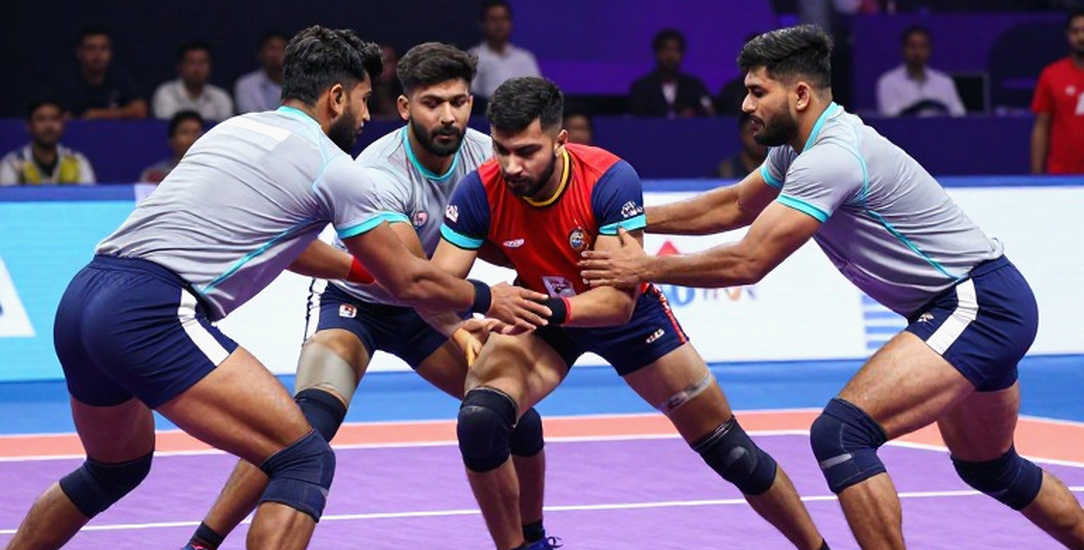
If raiding has changed, defending has changed even more. The old defence rested on individual courage — one defender went for the tackle alone, and if he missed, the raider was gone. The new defence rests on collective calculation. Five defenders move together, but they do not think together. Each has a fixed responsibility: the first will stop the contact, the second will close the escape route after that contact, the third will arrive from behind to complete the circle. This is called a chain tackle, and its most delicate element is timing. If the second defender moves a second early, the raider finds a path; if he moves a second late, the first defender is caught alone.
The ankle hold is considered the most reliable technique in this defence, because the defender's body stays low and his balance holds. The thigh hold is stronger but forces the defender to sacrifice his own axis. The dash is the technique in which a defender charges directly into the raider's body, and it works only when a partner is covering behind. In a block, the defender stops the raider's path with his own body, and this is the weapon of teams that are slower but disciplined. Iran's Fazel Atrachali built his reputation on reading timing in the ankle hold — he does not lunge early, he waits and extends his hand at the right moment. Corner defenders such as Surender Nada represent another face of this defence, changing a raider's angle without leaving their position.
This shift in defence changed the arithmetic of the game itself. When defence becomes collective, the probability of a super tackle rises, and a super tackle is not merely three points — it turns the mood of a match. After a super tackle, the opposing raider becomes cautious, his raid length shortens, and when raids shorten, the defence gains time to attack. One tackle thus influences the next four raids. In the old era, people counted tackles; now people watch what happened after the tackle.
The engine behind all of this is data and video analysis. Today every professional team has an analyst who records every raid of every match — who was raiding, from which side he came, which defender took the first step, where the contact landed, and what followed. These records produce patterns the eye cannot see. For instance, it may emerge that a particular raider touches the foot eighty percent of the time when he comes from the left half of the mat, but mostly places a hand on the shoulder when he comes from the right. That information is gold for a defender, because he no longer has to prepare for both possibilities on every raid.
The second use of video analysis is self-correction. A player is shown his own raid, in slow motion, and asked what he saw in that moment. This works because most errors in kabaddi come not from a lack of information but from a lack of time. When a player stops and watches his own raid, he sees options that were invisible to him on the mat. The next time that situation arrives, an extra option is already present in his mind. Player quality changes through this small habit.
But data has limits, and those limits must be acknowledged. Every raid in kabaddi is different because it involves seven bodies, their fatigue, and their mood that day. A pattern that worked across the last ten matches may fail in the next one precisely because the opposing coach has seen the same data and changed his habit. A good analyst, therefore, is not the one who gathers the most numbers, but the one who knows which number to forget on the mat.
Alongside data has come another thing: care for the body. Kabaddi is a harsh sport for the body. In a single match a raider bends, rises, and twists many times, while defenders fall and get up continuously. The effect lands on ankles, knees, hips and shoulders. In the old era, injury was accepted as fate. Now teams have physiotherapists, fixed recovery protocols, and a full warm-up schedule before matches. The biggest change is that players have begun to accept that hiding fatigue is not bravery.
The demands of fitness have also changed. Kabaddi does not require continuous running; it requires repeated sprinting and stopping. This is anaerobic capacity — the body must produce energy quickly without oxygen, then be ready again within a short interval. Modern training therefore includes short sprints, change-of-direction drills and strength work. A player who only trains with long runs will be less effective in the final five minutes of a match, because the demand then is not endurance but the ability to be fast again.
Amid all this, one question keeps surfacing: is this change altering the soul of the game? Some older fans say kabaddi once had a simplicity — one raider, one contact, and a verdict. Now everything is calculated. But there is a flaw in that argument. Kabaddi has always been a game of the mind; the difference is that the mind used to show only on the mat, and now it shows before the mat as well. When a coach reads an opponent's habit and changes his strategy, he is not spoiling the sport — he is giving it the same respect that chess receives.
If the picture at the professional level looks like this, the picture at the grassroots is mixed. In many parts of the country kabaddi is still played on mud, and players emerging from there still reach the top. This is the sport's greatest strength — the entry cost is low. A pair of shoes, an empty field and some friends, that is all it takes. Where cricket imposes the cost of pads, helmets, bats and coaching from the very beginning, kabaddi offers a chance to children of families that cannot spend on sport. That is why the game has produced so many players from rural India.
But low cost has a second face. Where cost is low, structure is often weak. In many places there are no trained coaches. Children play, but no one teaches them how to protect themselves when they fall. The result is that talent arrives early and ends early through injury. Steps taken to fill this gap include school-level competitions and events such as Khelo India, which gave young players a platform and pushed states to go out and find them.
The effect of these events is direct. When a state learns that a seventeen-year-old has reached the national level, its colleges and clubs begin to look toward him. This is a cycle, and the cycle turns only when competition exists at every level. If a player wins at the district level and stops there, he will not progress. A national platform is necessary, but the platforms below it are just as necessary.
One more thing demands attention: the participation of girls. Kabaddi is among the few sports in the country where a women's category has received international recognition, and the Indian women's team has earned its place by winning gold at the Asian Games. Yet domestically, there is still no equally large or equally visible platform for women. When girls see that the sport offers them a path to a livelihood, family resistance falls. That is a direct social change, and it is among the least discussed achievements of this sport.
Internationally, the picture has shifted quickly. Two decades ago, India's biggest problem was that it had no real challenger. Now Iran is the name of that challenge, and the challenge is not a polite one. The Iranian team's identity has been disciplined defence and physical strength, and it has troubled India in several major matches. Bangladesh has also been traditionally strong, and in recent years teams such as South Korea, Kenya and England have registered their presence. The meaning of this expansion is that India must now prove its place afresh every time — and rising competition raises the level of the sport.
This expansion has created a new problem, and it is the calendar. The league season is long, national camps run alongside it, and international competitions fall in between. The direct effect is on players' bodies. When a raider plays dozens of matches a year, his ankles and knees remain under constant load. Many teams now rest players for a few matches, but that decision is never easy, because every match carries weight.
The solution lies not only in medicine but in structure. If there are more teams domestically, and if the season is spaced so that players get room to breathe, injury rates can fall. Similarly, if the second tier of competition is strengthened, young players get opportunities and the load on senior players eases. Investment here is currently low, but the return will be long-term.
On the media and broadcast side too, the sport has taken a long leap. When a sport is broadcast in regional languages and edited quickly, its reach grows. One of kabaddi's great strengths is that it does not require a rulebook to understand. A first-time viewer understands by the second viewing what is happening. That simplicity is the sport's best marketing weapon, and it should be used more forcefully. Short videos, clips of the best raids, and post-match analysis have carried the sport to viewers who cannot watch a full match.
But the biggest challenge remains, and it is the quality of coaching. At the elite level there are foreign coaches, analysts and physios, but at the district level the old method persists, in which a coach merely runs drills and does not tell a player what he did wrong. Until coaches themselves are trained, new technique and new data will remain confined to a few cities. This requires separate coaching curricula with recognition, so that a good former player knows what to teach rather than merely repeating what he once learned.
There is one more area that rarely gets attention — the work away from the mat. In kabaddi, a large part of a player's success rests on habits: sleep, diet, and state of mind before a match. Teams that attend to these tend to make fewer mistakes at big moments. This work sounds boring, which is why it is discussed less, but results on the mat are built from it.
If today's picture must be summed up in a single sentence, it is this: kabaddi has moved out of the era of instinct and into the era of design, but its foundations still rest on the same mud. At the top, the sport has become fast, technical and full of calculation; at the bottom, the same old shortage of resources persists. The real challenge is bridging the gap between the two, and that gap is about coaching, not money. If a child in a village learns how to protect his wrist when he falls, and if his coach knows which habit in his raid can break an opponent, then the sport will have achieved its greatest strength — the kind that is invisible, yet leaves a mark on every scoreboard.
संबंधित खिलाड़ी
लोकप्रिय/पसंदीदा पुस्तकें
The Auction Makes the Noise; Kabaddi's Real Market Speaks in the Retention List2026-11-02
Kabaddi Report Unavailable: Empty Analysis Data Prevented Article Generation2026-10-31
Nigeria Is Fourth Without Playing a Match: What the Day 1 Table of the Commonwealth Kabaddi Championship 2026 Is Not Telling You2026-10-30
Commonwealth Kabaddi: India Open Against England and Malaysia, but the Real Test Is the 24-Hour Turnaround2026-10-30
India vs England, Commonwealth Kabaddi 2026: The Scoreline in Ahmedabad Will Reveal the Least2026-10-30
Commonwealth Kabaddi Championship 2026: Day 1 Table Hides a Story of Format, Selection and Medical Protocol2026-10-28
India Won 46-26, but Those 26 Points Sit Differently in the Notebook2026-10-25
अनुशंसित
Commonwealth Kabaddi Championship 2026: The 26 Hidden Behind the Scoreboard Before India vs Uganda2026-10-25
Pakistan's Kabaddi Withdrawal: The Circle-Style Bill Behind the Diplomatic Excuse2026-10-30
Kabaddi Report Unavailable: Empty Analysis Data Prevented Article Generation2026-10-31
Commonwealth Kabaddi Championship 2026: India Won 46-26, But the Real Story Is Hiding in the 262026-10-25
From Mud to Money: Noise, Signal and the Price the Scoreboard Never Shows in Kabaddi's Transfer Market2026-10-25
Kabaddi: From the Mud Akhara to the Global Stage — A Full Portrait of the Sport2026-11-01
India vs Uganda, Match 9: The Honest Column Behind 46-26, and Two Labels Still Unchecked2026-10-25
अनुशंसित
The List Before the Auction: Why Defence and Fame Carry Different Price Tags in the PKL Transfer Window2026-10-30
Nigeria Is Fourth Without Playing a Match: What the Day 1 Table of the Commonwealth Kabaddi Championship 2026 Is Not Telling You2026-10-30
Commonwealth Kabaddi: India Open Against England and Malaysia, but the Real Test Is the 24-Hour Turnaround2026-10-30
The Auction Makes the Noise; Kabaddi's Real Market Speaks in the Retention List2026-11-02
Commonwealth Kabaddi Championship 2026: The 26 Hidden Behind the Scoreboard Before India vs Uganda2026-10-25
Commonwealth Kabaddi Championship 2026: Day 1 Table Hides a Story of Format, Selection and Medical Protocol2026-10-28
Pakistan's Kabaddi Withdrawal: The Circle-Style Bill Behind the Diplomatic Excuse2026-10-30